
What to pack for Araucanía by season
In short
La Araucanía has a temperate, rainy climate with pleasant summers and cold winters, and it can rain in any month: Temuco's normal rainfall is 1,114.8 mm a year. Pack layers, rain gear, hiking shoes, a swimsuit and sunscreen; in winter, snow chains.
What to pack for Pucón or anywhere in La Araucanía depends on the season, but one rule holds all year: the climate is temperate and rainy, with pleasant summers and cold winters (source: Sernatur, chile.travel, January 2026), and in southern Chile it can rain in any month, even in summer (source: Sernatur, "Climate and weather").
Araucanía's climate in numbers
- Temuco: normal rainfall is 1,114.8 mm a year at the Maquehue station (source: Chilean Meteorological Office, DMC, checked on October 15, 2026).
- June is among the wettest months: Temuco's normal is 177 to 258 mm (source: DMC, 1991-2020 normals, quoted by Meteored). October is around 81 mm (same source, October 2024).
- Andes: rainfall reaches about 3,000 mm a year, and above 1,500 meters it falls as snow, with temperatures below 0 °C (source: Library of the National Congress of Chile, undated).
- Warmest months: highs of about 23 °C (same source).
The basics for any season
Dress in layers and bring hiking shoes, a swimsuit for the hot springs, a warm jacket and sunscreen (source: Sernatur, chile.travel). On trails, CONAF asks for hiking shoes, waterproof clothing and warm layers (source: CONAF, Malalcahuello National Reserve). Pack a rain jacket even if the forecast looks good.
Summer
- Sun: in January 2025 Chile's weather office reported an extreme UV index in La Araucanía, the top level of its scale (source: Meteochile, quoted by En Cancha, January 21, 2025). Wear sunscreen, a hat and long sleeves, and avoid the midday sun (same source).
- Horseflies (coliguachos): most common from December to February. A Universidad de Los Lagos academic recommends light-colored clothing, long sleeves and avoiding the hottest hours (source: La Tercera, January 13, 2025). The source does not mention repellents.
- Storms: some trails in Malalcahuello carry a lightning risk between November and April (source: CONAF).
- Villarrica volcano: climbing to the crater requires a certified guide and technical gear (source: Sernatur). See Villarrica Volcano.
Autumn and spring
The rain continues: in Temuco, April's normal is 52 to 108 mm and October's is around 81 mm (source: DMC, quoted by Meteored). Add waterproof shoes and a warm layer. See what each season offers in autumn and spring.
Winter
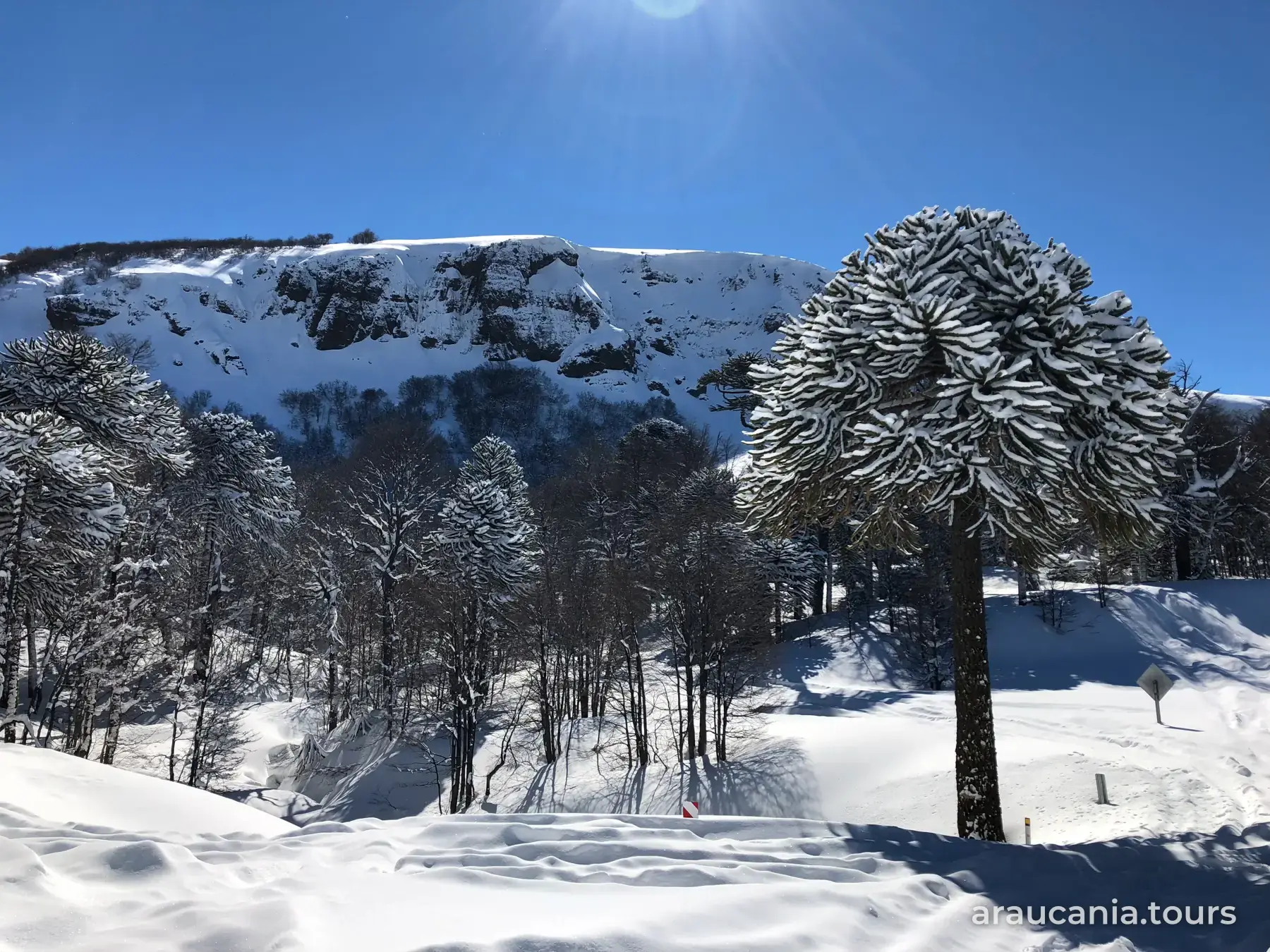
- Snow: between June and September, snow or ice can close access to several mountain destinations (source: Sernatur, chile.travel, May 2026). Huerquehue National Park may have snow on its trails in those months (source: CONAF).
- Snow chains: carry chains if you travel in snowfall season; for most of those destinations a 4WD or at least a high-clearance vehicle is recommended (source: Sernatur, May 2026). On the Las Raíces pass, on route CH-181 between Curacautín and Lonquimay, chains are mandatory in winter (source: Araucanía Andina). Check road conditions with Vialidad (MOP) or Carabineros before setting off.
- Clothing: dress warmer than you think you need to (source: Sernatur). For skiing at Corralco Ski Resort, wear layers: mountain weather changes fast (source: Sernatur).
- Signal: mobile coverage is limited or non-existent in several mountain areas (source: Sernatur).
More seasonal ideas for summer and winter. And if you are traveling without a car, see Getting around Araucanía without a car.
Information reviewed on October 15, 2026. Weather and road conditions change: check the forecast at meteochile.gob.cl and CONAF and Vialidad notices before you travel.
Frequently asked questions
Does it rain in summer in La Araucanía?
Yes, it can rain in any month, even in summer; always pack a rain jacket (Sernatur, "Climate and weather").
What should I pack for Pucón?
Layers, hiking shoes, a swimsuit, a warm jacket and sunscreen (Sernatur, chile.travel, January 2026).
How much does it rain in Temuco?
Normal rainfall is 1,114.8 mm a year, and June is among the wettest months (Chilean Meteorological Office).
Do I need snow chains in winter?
Yes: Sernatur recommends carrying them in snowfall season, and on the Las Raíces pass they are mandatory in winter (Sernatur; Araucanía Andina).
How do I avoid horseflies in summer?
Wear light colors and long sleeves and avoid the hottest hours (La Tercera, January 2025, quoting a Universidad de Los Lagos academic).
Sources: Sernatur, chile.travel: «Pucón Hot Springs: two days of absolute relaxation» (actualizado el 15-ene-2026), «Climate and weather» (sin fecha), «Dónde ver nieve en Chile si no quieres o no sabes esquiar» (26-may-2026), fichas de Volcán Villarrica y Corralco; Dirección Meteorológica de Chile, climatologia.meteochile.gob.cl, estación Maquehue Temuco Ad. 380013 (consultada el 15-oct-2026); Meteored, normales DMC 1991-2020 de abril y junio, y normal de octubre (10-oct-2024); Biblioteca del Congreso Nacional, «Clima» Región de La Araucanía (bcn.cl/siit, sin fecha); CONAF, Reserva Nacional Malalcahuello y Parque Nacional Huerquehue (consultados el 15-oct-2026); En Cancha, índice UV extremo según Meteochile (21-ene-2025); La Tercera, «Temporada de coliguachos» (13-ene-2025); Araucanía Andina, ficha Cuesta Las Raíces. Revisado el 15-oct-2026.